
In a nutshell: The E-Jen (sold as the Crazy Korean Cooking container) is a Korean-designed fermentation vessel with an adjustable inner "vacuum" lid that sits right on top of your ferment and a tiny one-way valve that lets CO₂ out without letting air back in. In practice that means no weights, no daily burping, and a sealed second lid that keeps even kimchi from scenting the whole fridge. After several years of fermenting in all kinds of vessels, I own five of these and reach for them for nearly all my larger ferments. It comes in nine sizes, from 1.7L up to 17L. Fermentation still throws the occasional dud—a hot week, a little kahm yeast—the same as with any container. But the E-Jen is by far the easiest, most convenient vessel I've used, and it's made me ferment a lot more.
This post contains affiliate links. If you buy through them I may earn a small commission at no extra cost to you. I only recommend gear I actually use.
What is the E-Jen fermentation container?
The E-Jen is a food-grade polypropylene fermentation container with a two-lid system: an adjustable inner lid that presses down onto the food to push out air, plus an airtight outer lid. A small valve in the inner lid acts as a one-way airlock, venting carbon dioxide while blocking oxygen. It's designed for vegetable ferments like kimchi, sauerkraut, and pickles, and it replaces the separate weights and airlocks a jar setup needs.
It's the modern descendant of the onggi—the traditional Korean earthenware crock used to ferment kimchi for some two thousand years—keeping the idea while ditching the weight and fragility. (More on what it genuinely borrows from onggi, and what's just marketing, in the science section below.)
If you've seen it under the name "Crazy Korean Cooking container," that's the same product—E-Jen is the maker, Crazy Korean Cooking is the brand it's sold under in the US.
Key Takeaways
- Two-lid system: the E-Jen pairs an adjustable inner lid that presses food under the brine with a one-way valve, so there are no weights and no daily burping.
- Odor control: the E-Jen's sealed outer lid keeps pungent ferments like kimchi from scenting the whole fridge, making counter fermentation livable.
- Best for vegetables: the E-Jen is optimized for lacto-fermented veg like sauerkraut, kimchi, and pickles, not kombucha or ferments needing different airflow.
- It's plastic, not clay: the E-Jen is food-grade polypropylene (BPA-, DEHP-, and lead-free); the vacuum lid does the work, not any "breathing clay."
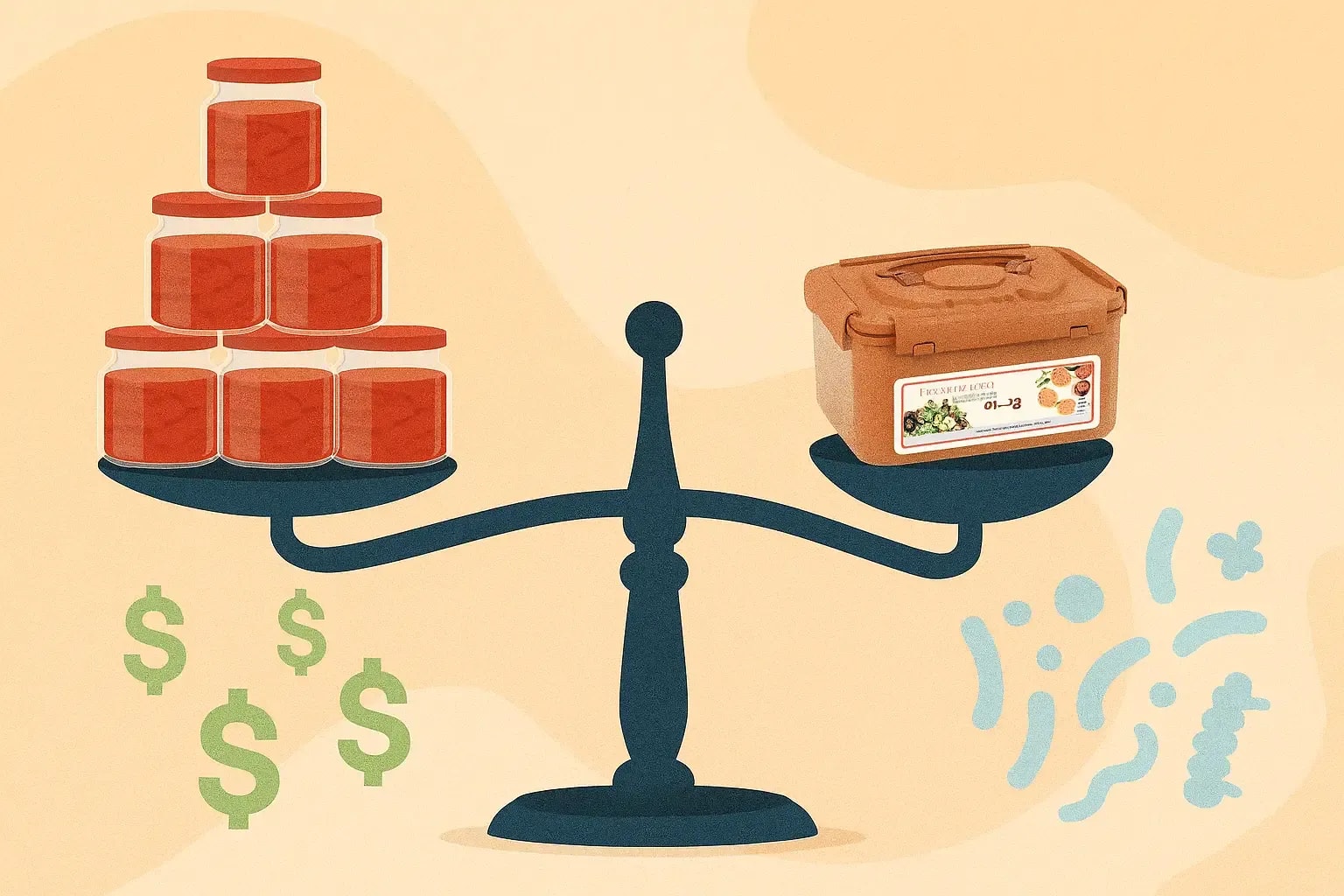
- Worth it for convenience: a 3.4L E-Jen runs roughly $45-55; pricier than a mason-jar setup, but far easier, so you ferment more.
Why I reach for the E-Jen (and own five)
Let me be clear up front: I get great results in lots of vessels. My mason jars work beautifully, and so do the other containers I've used over the years. Fermentation troubles are rare for me—an occasional dud from a hot stretch of weather, a little kahm yeast now and then (usually harmless and easy to skim off). That's just normal fermenting, and no container makes it vanish entirely.
So this isn't a story about the E-Jen rescuing me from failure. It's simpler than that: it's the most comfortable, convenient container I own, by a wide margin. I have five of them, and they handle all my larger ferments. Sauerkraut, pickles, cauliflower, carrots, and a long list of others go into an E-Jen exclusively now. Small batches and things like onions still go in a mason jar—but for almost everything else, this is what I reach for.
The reason is the lid system. I never have to think about keeping vegetables under the brine—the adjustable inner lid presses everything down and keeps it submerged on its own, and the sealed outer lid takes care of the smell. No weights to wrestle with, nothing to burp. That convenience compounds: because it's so easy, I ferment far more than I used to, and I enjoy it more. If I had to give up every fermentation container but one, this is the one I'd keep.
How the vacuum lid actually works
This is the part that matters, and it's worth understanding before you buy—because the lid, not the container material, is what does the work.
The two-lid system
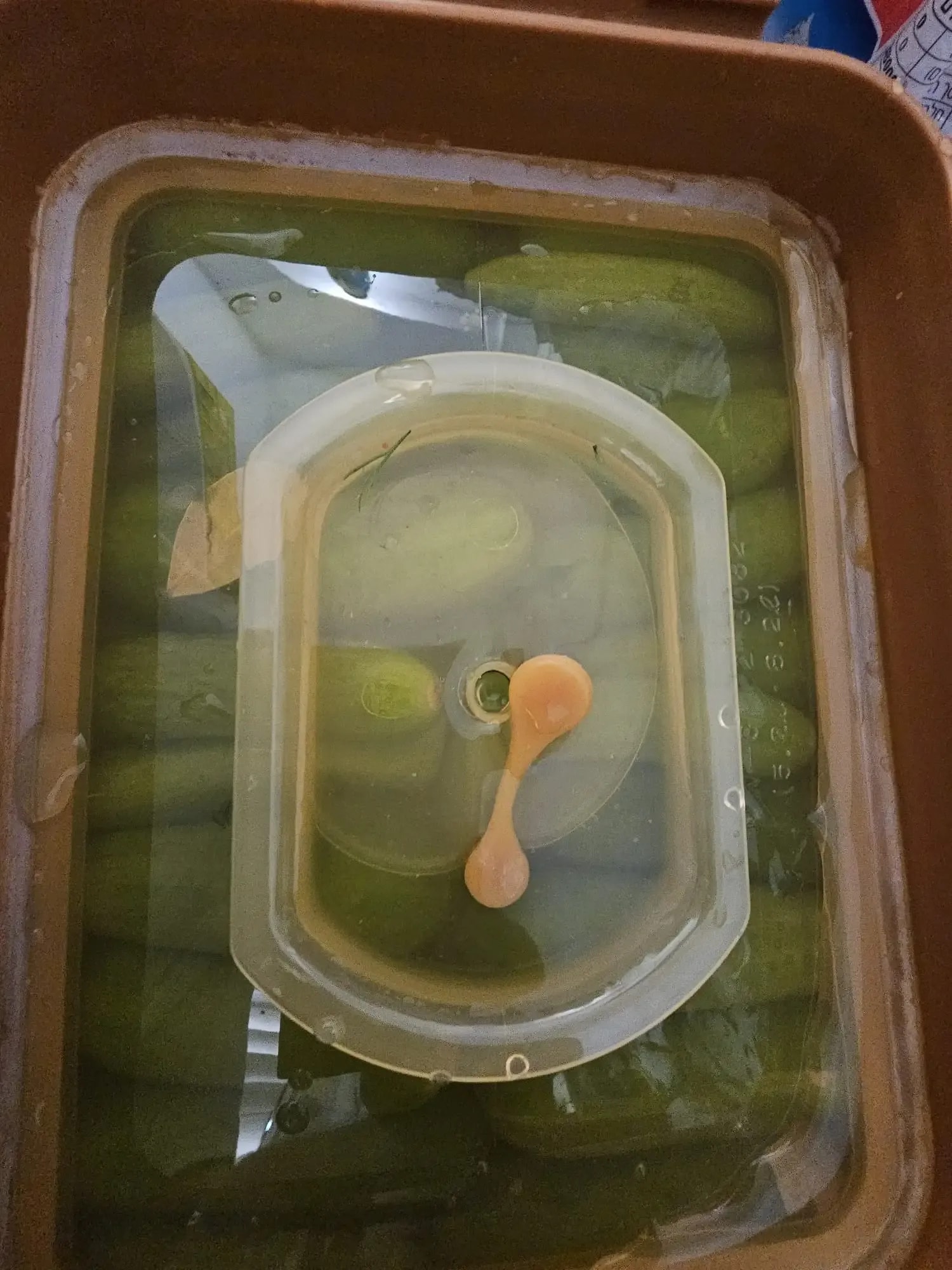
The inner lid is a plate that drops down inside the container and adjusts to whatever level your food sits at. As you press it down, it pushes air out and brine up, so your vegetables end up submerged under liquid with very little air above them. No separate weight, no glass disc, no cabbage-leaf trick.
Built into that inner plate is a small valve—just an opening with a removable rubber plug. During active fermentation you leave it open. As CO₂ builds up and escapes, a little brine pools around the opening and forms a natural liquid airlock: gas can bubble out, but air can't get back in. That's why there's no daily burping.
The outer lid twists down on top and seals everything. Its main job is containing smell. Kimchi is pungent by nature, and a regular jar lets that out every time pressure releases—the double-lid setup keeps it contained far better, which is the difference between fermenting on your counter and exiling jars to the garage.
The four problems it's solving
Most vegetable-fermentation headaches come down to four things, and the design targets all of them at once:
- Air exposure → mold. The inner lid keeps food submerged and the air gap minimal, so aerobic mold and kahm yeast have little to colonize.
- CO₂ buildup → overflow or pressure. The valve vents gas continuously instead of letting it accumulate.
- Uneven pressure → mushy spots. Even, gentle pressure across the surface helps avoid the "perfect in one spot, mush in another" problem.
- Smell → unhappy housemates. The sealed outer lid keeps odors in.
None of this requires you to babysit anything. You set it up once and check on it when you feel like it.
The science: what onggi gets right
Here's where it's worth separating real mechanism from marketing copy.
For roughly two thousand years—Korean earthenware fermentation vessels are commonly dated to around 57 BC—onggi have been prized for producing exceptional kimchi. The traditional explanation is that the porous clay "breathes." Until recently that was folklore more than measurement, but in 2023 researchers at Georgia Tech actually tested it. Fermenting salted cabbage side by side in an onggi and a sealed glass jar, they found the onggi kept internal CO₂ levels below half those of the glass jar, and the beneficial lactic-acid bacteria grew about 26% more. In the sealed glass jar, the bacteria were essentially suffocating in their own carbon dioxide [1].
The takeaway isn't "buy clay." It's that lactic-acid bacteria thrive in a low-oxygen environment that still lets CO₂ escape—not a fully sealed one where gas piles up. That's the target.
So where does the E-Jen fit? Honestly: the manufacturer adds 7–10% natural clay to the sandy-brown models and leans on the onggi "breathing" story, but a mostly-plastic container doesn't breathe through its walls the way real earthenware does. The clay is mostly a nod to the heritage. What genuinely recreates that ideal environment is the vacuum lid and one-way valve—they give you low oxygen with continuous CO₂ venting, mechanically, which is exactly the condition the research says the bacteria want. The E-Jen reaches the onggi's destination by a different road, and that's a more honest way to think about it than "magic breathing pot."

E-Jen size guide
The containers run from small test sizes to commercial volumes. The trick most people miss: you only fill to about 80%, because fermentation creates extra liquid and gas. So a "5.2L" container holds closer to 4L of actual food. Here's how the sizes shake out and who each one suits.
| Stated volume | Working capacity (~80% fill) | Good for | Link |
|---|---|---|---|
| 1.7L | ~1.4L | Test batches, one person | Buy 1.7L |
| 3.4L | ~2.7L | 1–2 people, one small cabbage | Buy 3.4L |
| 5.2L | ~4.2L | Small families, weekly ferments | Buy 5.2L |
| 6.4L | ~5.1L | 3–4 people, two small cabbages | Buy 6.4L |
| 7.4L | ~5.9L | Large families, bulk prep | Buy 7.4L |
| 8.5L | ~6.8L | Serious, regular fermenters | Buy 8.5L |
| 11L | ~8.8L | Small business, events | Buy 11L |
| 12L | ~9.6L | High-volume fermenting | Buy 12L |
| 17L | ~13.6L | Professional / commercial | Buy 17L |
Which size should you actually get?
If you're buying your first one, the 3.4L is the size I'd point most people to. It handles a single small cabbage's worth of kraut or a normal kimchi batch, and it still fits in a fridge without a fight. One or two people can usually stop there; families tend to be happier with the 5.2L or 6.4L.
One thing I've learned: two medium containers usually beat one giant one. They fit the fridge more easily, and you can run two different ferments at once instead of committing a huge vessel to a single recipe. If you catch the fermenting bug, you'll likely end up with a couple of sizes rather than one big workhorse.
How to use the E-Jen, step by step
After enough batches, this is the routine that works for me.
First use only. Wash every part in hot soapy water and let it dry. You can pour boiling water over the container if you want to sanitize it—it handles heat fine. Check that the valve plug slides in and out easily.
- Prep your vegetables. Weigh them on a kitchen scale so you can salt accurately—I use roughly 2–2.5% salt by weight for most vegetable ferments, adjusting to the recipe. Massage or pack until they release their own brine.
- Load to about 80%. Pack firmly but don't crush, and leave that top fifth empty for the liquid and gas to come. Make sure brine covers the vegetables.
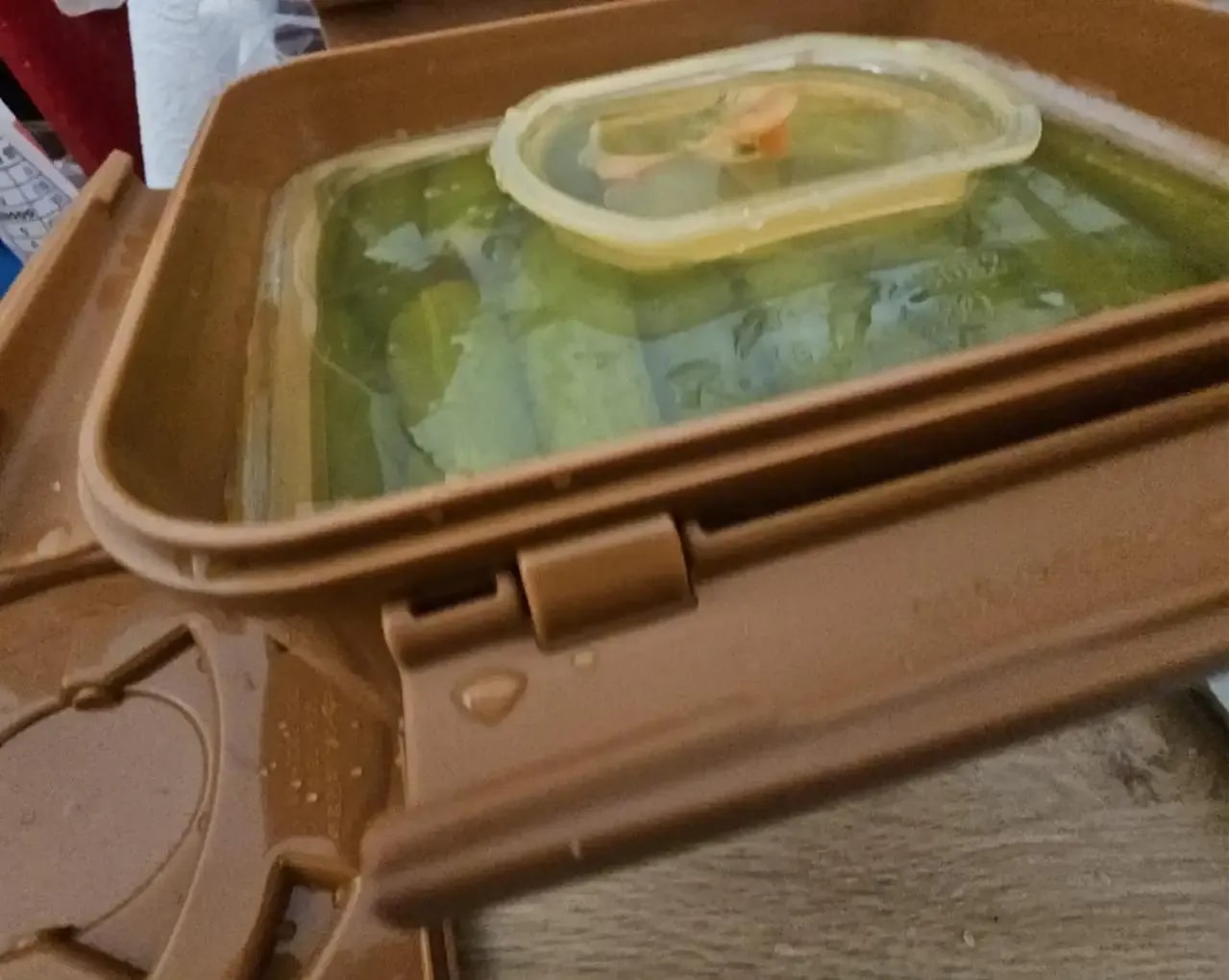
- Set the inner lid. Pull the valve plug up to the open position, then lower the inner lid slowly. Watch brine rise through the valve hole and stop when a little pools around the opening—that pool is your airlock.
- Seal it. Twist the outer lid down. That's the whole setup. No weight, no burping, no checking.
- Watch it ferment. You'll see bubbles through the side when it's active. Timing depends on what you're making and how warm your kitchen is: quick pickles in 2–3 days, sauerkraut usually 1–3 weeks, kimchi around 3–7 days before it moves to the fridge to keep developing.
- Move to cold storage. Once it tastes right, push the valve plug down to close it and refrigerate. Properly fermented vegetables keep for months.
A couple of small habits help: keep a little extra brine in a jar to top off if a batch looks low, and resist opening the outer lid to "check"—you can read progress from the bubbles and a careful sniff at the lid seam.
Honest pros and cons
No vessel is perfect, and the most useful thing I can give you is a straight account of the trade-offs.
What's genuinely good:
- No weights or burping. The single biggest convenience. Set it and leave it.
- Submersion takes care of itself. The inner lid keeps everything under the brine on its own—no weights, no checking, no floaters poking up to grow mold.
- Real odor control. The sealed outer lid is what makes counter fermentation livable, especially for anything pungent.
- Everything's included. No buying separate airlocks, weights, or pump systems—the lid is the whole system.
- It's tough. Dishwasher-safe, takes boiling water, and there's no glass to shatter.
What to go in knowing:
- It's plastic. Food-grade polypropylene, free of BPA, DEHP, and lead—but if you specifically want to ferment only in glass or true ceramic, this isn't that. (If that's you, a real stoneware crock is the move, at a much higher price.)
- The "breathing clay" is marketing. As covered above, the vacuum lid does the work; don't buy it expecting the walls to behave like a genuine onggi.
- You can't watch from the top. The outer lid is opaque, so you read progress through the sides and by lifting the lid, not through a clear top.
- It's for vegetables. It's optimized for lacto-fermented veg. I use other vessels for kombucha and anything that wants different airflow.
- Big sizes eat fridge space. Plan around your actual fridge before buying a 7L+ model.
Is the E-Jen worth it?
A 3.4L E-Jen runs roughly $45–55 depending on the day. Here's how that compares to the alternatives:
| Setup | Rough cost | What you get |
|---|---|---|
| Mason jar + weight + airlock lid | $25–35 | Cheaper; more fiddly; multiple parts to manage |
| E-Jen container | $45–55 | All-in-one; no weights/burping; strong odor control |
| Small stoneware crock | $80–150 | Traditional, beautiful, heavy; usually needs weights |
| Vacuum-bag system | $40–60 | Compact; consumable bags; less reusable |
A jar setup is the budget pick and it works fine—I still use mine. The case for the E-Jen isn't that it's cheapest; it's that it's by far the easiest. The weights, the burping, the checking to make sure nothing's floating above the brine—it takes care of all of it, so you ferment more and fuss less. And it pays for itself quickly against $8–12 jars of store-bought kimchi.
It also makes a genuinely good starter gift for anyone curious about fermentation—the 3.4L lowers the barrier enough that people are far more likely to stick with it.

Just fan art, of course—not an actual E-Jen depicted here.
Final thoughts
After years of fermenting in all kinds of containers, the E-Jen is the one I reach for first. Not because it's flashy, and not because it makes failure impossible—no container does that. It's because it's so easy and pleasant to use that I ferment far more than I otherwise would, with the same great results I get anywhere else and a lot less fuss.
That's the honest pitch. If you're happy fermenting in jars and the routine doesn't bother you, you can absolutely keep doing that—I still use mine for small batches. But if you ferment a lot, or want to, the E-Jen makes it so much easier and more enjoyable that you'll probably find yourself reaching for it first, the way I do. For most people the 3.4L is the place to start.
Want to go deeper on technique? The Noma Guide to Fermentation is the book I'd recommend, and you can browse the rest of my fermentation equipment for the bits that pair well with it. Questions about the E-Jen or fermentation in general? Leave them in the comments.
References
- Onggi and kimchi fermentation: Kim S, Hu DL. "Onggi's permeability to carbon dioxide accelerates kimchi fermentation." Journal of the Royal Society Interface, 2023. Royal Society Interface · Georgia Tech summary
Some links above are affiliate links. If you purchase through them, I may earn a small commission at no extra cost to you—it helps keep Fermentfulness free. I only recommend products I personally use and trust. Prices and availability change, so check the current listing before buying.