
As I write this, looking back on 2025, I'm genuinely amazed at how far I've come. If you'd told me a year ago that I'd be walking into 2026 feeling this much stronger, lighter, and more in control of my body, I'm not sure I would have believed you.
For those who don't know my story: I live with both psoriasis and fibromyalgia. If you're dealing with either of these conditions, you know exactly what I mean when I say some days, just getting out of bed feels like climbing a mountain. The chronic pain, the fatigue, the unpredictable flares, the itchy, inflamed skin patches that make you want to hide—it can be absolutely exhausting.
But 2025 was different. This was the year I built my healing arsenal—a combination of foods, supplements, tools, lifestyle changes, and yes, a lot of fermentation—that has genuinely transformed how I feel day to day. I lost over 10% of my body weight, brought my BMI from obesity (32) down to 27, dramatically reduced my psoriasis patches, and perhaps most importantly, regained energy and function I thought fibromyalgia had stolen from me permanently.
This article is my complete download—everything I used, everything I learned, and everything I'm carrying forward into 2026. Maybe something here will help you too.
The Foundation: Dr. William Davis's SIBO Yogurt Protocol

If I had to choose just one thing that moved the needle most dramatically this year, it would be SIBO yogurt. This isn't your typical store-bought yogurt with dead probiotics and added sugar. This is a therapeutic, ultra-fermented yogurt based on the protocol from Dr. William Davis's book Super Gut—and it has become the cornerstone of my daily routine.
Making SIBO yogurt requires precision. The extended 36-hour fermentation at exactly 100°F (38°C) demands consistent temperature control, which is why my Anova Culinary Sous Vide Precision Cooker Pro has become absolutely essential. It maintains that perfect temperature throughout the long fermentation, ensuring the probiotic strains multiply to therapeutic levels.
The Three Probiotic Strains

My SIBO yogurt contains three specific strains, each chosen for their unique therapeutic benefits:
Lactobacillus reuteri: L. reuteri has been studied for effects on skin and inflammation, mostly in early or animal research. I find the idea appealing for my psoriasis, but the human evidence is preliminary and it's not a substitute for standard psoriasis care — I include it as part of my own routine. I source mine from BioGaia Gastrus tablets, which provide a reliable, high-quality starter culture.
Lactobacillus gasseri: Known for its metabolic benefits and gut barrier support. Research suggests it may help with weight management and reducing visceral fat—something that absolutely aligned with my weight loss goals this year. I use Dr. Mercola's BioThin L. Gasseri BNR17 as my source.
Bacillus coagulans: A spore-forming probiotic that survives stomach acid remarkably well and supports digestive health. This hardy strain adds resilience to the yogurt's probiotic profile. I get this from Schiff Digestive Advantage.
(Update: this reflects the recipe I was running earlier. Dr. Davis has since replaced B. coagulans with B. subtilis HU58, which is cultured separately at a lower temperature and combined afterward — see our 2025 SIBO Yogurt Update for the current method.)
How I Eat It Every Morning

Every single morning starts with my SIBO yogurt muesli bowl. Here's what goes in: a generous serving of the yogurt as the base, rolled oats for fiber and sustained energy, fresh or frozen fruits (usually berries or banana), natural peanut butter for protein and healthy fats, and depending on my mood—chia seeds for extra omega-3s or cacao nibs for that chocolate fix without the sugar.
I also mix my creatine supplement directly into this bowl. Creatine isn't just for bodybuilders—it supports cellular energy production generally. Whether that translates into a fibromyalgia benefit isn't established (fibromyalgia is a central-sensitization condition, not a proven mitochondrial disease), so I include it as part of my own routine rather than as a treatment. The yogurt masks any grittiness and makes it easy to stay consistent.
Beyond the Bowl: Creative SIBO Yogurt Applications

I don't stop at breakfast. The beauty of SIBO yogurt is that it becomes a base for so many other therapeutic foods:
Labneh cheese: Strain the yogurt through cheesecloth overnight, and you've got a thick, tangy Middle Eastern cheese packed with concentrated probiotics. I use my Ellie's Best nut milk bag for this—the fine mesh creates the perfect consistency without losing any of the precious yogurt.
Tzatziki: Mix with grated cucumber, fresh garlic, good olive oil, dill, and a squeeze of lemon. This goes on everything—grilled meats, roasted vegetables, or honestly, just eaten straight with a spoon when I need a snack.
Fruit shakes: Blend with frozen berries, a banana, and maybe some spinach for a probiotic-rich smoothie that actually tastes indulgent. It's become my go-to afternoon pick-me-up.
My Daily Supplement Stack

Supplements are controversial—I get it. But for managing chronic conditions like psoriasis and fibromyalgia, targeted supplementation has been non-negotiable for me. Here's my daily protocol and the reasoning behind each choice:
The Daily Non-Negotiables
- Vitamin D3 (10,000 IU): I take two capsules daily of California Gold Nutrition Vitamin D3 5,000 IU. Yes, this is well above standard recommendations — 10,000 IU/day is over the commonly cited 4,000 IU/day upper limit and can cause toxicity if it's not monitored — so I only do it because I check my blood levels and work with that data. Please don't copy this dose without a doctor and periodic blood testing; it's not a general recommendation. Vitamin D deficiency is rampant, especially in autoimmune conditions, and research consistently shows its importance for immune regulation and skin health. It's also essential for proper absorption of nutrients from all those fermented foods I'm eating.

- Vitamin K Complex: Always pair high-dose D3 with K2—this is crucial. I take California Gold Nutrition Vitamin K Complex, which includes both K1 and K2. This combination ensures calcium gets directed where it should go (bones and teeth) rather than where it shouldn't (arteries and soft tissue).

- NMN (Nicotinamide Mononucleotide): This one is specifically for fibromyalgia. NMN is a precursor to NAD+, which is involved in cellular energy production. I'll be honest that the idea of NAD+ depletion "causing" fibromyalgia fatigue is speculative, not established — fibromyalgia is understood as a nervous-system pain-processing condition (central sensitization). I take NMN as a personal experiment and have noticed more energy, but that's anecdote, not proof. I use California Gold Nutrition NMN 175mg, and since starting it, my energy levels have noticeably improved.

- Omega-3 Fatty Acids: The anti-inflammatory benefits are well-documented. I take California Gold Nutrition Omega-3 Premium Fish Oil daily. For psoriasis especially, omega-3s support skin barrier function and help interrupt the inflammatory cascade that drives flares.

- Niacin (Vitamin B3): A more recent addition to my stack, specifically to help with inflammation and skin health. I use NOW Foods Flush-Free Niacin 500mg—the flush-free version is important because regular niacin can cause an uncomfortable flushing sensation. The evidence for niacin in inflammatory skin conditions is limited, and it's worth knowing that "flush-free" niacin (inositol hexanicotinate) behaves differently from regular niacin in the body — so I treat this as a personal experiment, not an established skin treatment.
The As-Needed Additions
-
Magnesium Lysinate Glycinate: I reach for this after intense workouts or when my muscles are particularly sore and tight. I use Doctor's Best High Absorption Magnesium Lysinate Glycinate—the chelated form is highly bioavailable while being gentle on the stomach. Magnesium is critical for muscle function and recovery.
-
Ultra Tart Cherry Extract: I take this before sleep, especially after hard training days. Nature's Truth Ultra Tart Cherry Extract 1,200mg is my go-to. Tart cherry is a natural source of melatonin and has proven anti-inflammatory properties that support recovery. My sleep quality has definitely improved since incorporating this into my routine.

The Soap That Changed Everything

I need to talk about this soap, because it might have been my single biggest discovery of 2025—and I'm genuinely shocked I hadn't heard about it until this year.
Grandpa's Pine Tar Soap carries the National Psoriasis Foundation's Seal of Recognition — which means it's considered non-irritating and suitable for sensitive, psoriasis-prone skin (not a claim that it treats or clears psoriasis). After using it daily for months, I've found it genuinely helpful for me. Let me be honest upfront: it smells... strong. Like a campfire. Like a forest after rain. Like something undeniably medicinal. My partner wasn't thrilled at first.
But within one to two weeks of daily use, I started seeing visible improvement in my psoriasis patches. The angry redness began to fade. The thick scaling decreased noticeably. And most importantly, the itchiness—that maddening, constant, makes-you-want-to-crawl-out-of-your-skin itchiness—finally, finally calmed down.
Pine tar has been used traditionally for skin conditions for a very long time. To be clear about the science, though: the "slows skin-cell growth" mechanism is well documented for coal tar (an FDA-recognized OTC psoriasis treatment), not pine tar — pine tar is a different substance, sold as a cosmetic rather than an approved drug, with a much thinner evidence base. I can only speak to my own experience with it. The relief from itching alone has been life-changing. Yes, you'll smell like a lumberjack for a few minutes after your shower. Yes, it's absolutely worth it.
I've written a full detailed review of this soap elsewhere on the blog—that's how important it's been to me. If you have psoriasis and haven't tried pine tar, it might be worth a look — it's inexpensive and, for me, genuinely helpful. Two honest caveats: "natural" doesn't mean risk-free (pine tar can cause an allergic skin reaction in a small number of people, so patch-test a small area first), and a soap is at most an add-on, not a replacement for the plan your dermatologist gives you.
The Ferments: My Rotating Cast of Gut-Healing Heroes

This is Fermentfulness, so of course fermentation is central to my protocol. But I want to be clear: I don't ferment everything all the time. That would be overwhelming and completely unsustainable. Instead, I have a rotating cast of staples that I return to again and again, plus seasonal experiments that keep things interesting.
My Regular Rotation
-
Fermented Mini Cucumbers/Pickles: The gateway ferment. Quick to prepare, deeply satisfying, and endlessly snackable. I keep these going constantly throughout the year.
-
Sauerkraut: The classic for good reason. Simple ingredients (just cabbage and salt), but complex, tangy results. For larger batches, I use my E-Jen 11L fermentation container—the Korean vacuum-lid design has been a complete game-changer. Zero mold issues, perfect ferments every single time. For smaller batches, I rely on my Paksh wide mouth mason jars with Masontops pickle pebble weights to keep everything properly submerged.

-
Fermented Spicy Carrots: These are genuinely addictive. The fermentation mellows the heat while adding that signature tangy depth that makes everything better.
-
Fermented Cauliflower: Criminally underrated. The texture holds up beautifully through fermentation, and the result is incredible in grain bowls, as a side dish, or just eaten straight from the jar.
-
Fermented Onions: My secret weapon ingredient. These transform sandwiches, salads, tacos, and pretty much anything savory. The fermentation completely tames the sharp bite while adding incredible depth and complexity.
The Equipment That Makes It Work

Good fermentation requires good tools. Beyond the E-Jen containers and mason jars I mentioned, here's what I rely on:
For traditional larger batches, my Ohio Stoneware 2-Gallon Fermentation Crock is beautiful and functional—there's something deeply satisfying about fermenting in proper stoneware. For medium-sized batches, my E-Jen 5.2L container hits the sweet spot.
Ball Leak-Proof Plastic Lids are essential for storing finished ferments—metal lids and acidic brine are a recipe for rust and off-flavors.
My OXO Good Grips Food Scale ensures I nail the salt ratios every time—precision matters when you're dealing with fermentation chemistry.
The Yinmik Digital pH Meter helps me monitor fermentation progress and ensure safety, especially when I'm experimenting with new recipes.
And my U.S. Kitchen Supply Over-the-Sink Colander makes rinsing and draining vegetables a breeze—it spans the sink and gives me plenty of space to work.
The beauty of fermentation is that the options are nearly endless. As the seasons change, so do my ferments. But these staples form the backbone of my gut-health strategy, ensuring I'm getting a diverse range of beneficial bacteria every single day.
Movement: Training Through Fibromyalgia

I need to be honest here, because I know some of you reading this have fibromyalgia and are thinking, "Exercise? Is he serious?"
I am. And I know how impossible it can feel.
Those of you with fibro understand: some days, climbing stairs feels like scaling Everest. Some days, just leaving the house requires more energy than you have. The fatigue isn't normal tiredness—it's bone-deep exhaustion that makes every movement feel like you're wading through concrete.
But 2025 was the year I decided to push through anyway. Not every day—I'm not superhuman, and I've learned to respect my body's genuine limits. But most days. And it has made all the difference.
My Movement Protocol
Gym workouts (3-5 times per week): I focus primarily on strength training because building muscle has been shown to help with fibromyalgia pain and fatigue. I started slowly—and progressively increased. This year I've gained significant strength, strength I genuinely didn't think my body was capable of anymore.
Cycling: Low-impact cardio that gets my heart rate up without destroying my joints. I cycle regularly, both for exercise and for transportation when the weather cooperates.
Daily dog walks: Non-negotiable movement. My dog doesn't care if I'm tired—she needs her walks. And honestly, this built-in accountability has been crucial. Even on the worst fibro days, I get my steps in because she's counting on me.

The Weight Loss Journey
This combination of consistent movement and improved nutrition led to something I'd been struggling with for years: meaningful, sustainable weight loss. I was technically in the obesity range, even though I never "looked" obese (BMI isn't a perfect measure, I know). My BMI was over 32; I weighed 106 kg (about 234 pounds).
Today, my BMI is 27. I weigh 92 kg (about 203 pounds). That's 14 kg lost—over 30 pounds—representing more than 10% of my starting body weight.
The impact on my energy levels has been profound. The impact on how I feel moving through the world has been profound. And I truly believe this weight loss has contributed to reduced inflammation overall, which helps both my psoriasis and fibromyalgia symptoms.
The Mindset Piece
Here's what I've learned: the body doesn't always want to move. With fibro, it often actively resists—sometimes screams at you to stop. But showing up anyway—even when everything hurts, even when I'm exhausted—strengthens not just my body but my mind. Every workout completed on a hard day is proof that I'm stronger than this condition. Every step taken when my body screams "stop" is a small victory against the limitations chronic illness tries to impose. It's important to have a routine, and equally important to climb back into that routine quickly after the inevitable slides. Because there will be slides—the key is not letting them become permanent detours.
The Biggest Change: Leaving Hi-Tech

I haven't talked about this much publicly, but it's a crucial piece of my 2025 healing story: I quit my hi-tech software development job.
It was a good job by conventional standards. Good salary. Stable career. Prestige in the industry. But the stress was killing me—maybe literally. Chronic stress is a well-documented trigger for both psoriasis flares and fibromyalgia symptoms, and I was drowning in it. The deadlines, the pressure, the endless context-switching, the meetings that could have been emails—it was all taking a measurable toll on my health.
Now? Honestly, I work more hours than I ever did in hi-tech. Significantly more. I have multiple projects running simultaneously, including this passion project you're reading right now. The financial stability isn't there yet—not nearly at the level of my previous tech salary.
But here's the crucial difference: I love what I do. Every project I work on is something I'm genuinely passionate about, something I actually look forward to tackling each day. The anticipation to work has replaced the Sunday-night dread. Creative fulfillment has replaced burnout. I wake up excited rather than exhausted before the day has even begun.

Is there still stress? Absolutely. New stresses, different stresses—financial uncertainty, client deadlines, the pressure of building something from scratch. But these stresses feel manageable because I'm building something meaningful on my own terms. Health is priceless, and I decided to prioritize it. That decision alone has probably done more for my inflammation levels than any supplement ever could.
The Results: What Actually Changed

So after a full year of this protocol—the SIBO yogurt, the targeted supplements, the pine tar soap, the fermented foods, the consistent movement, the major lifestyle shift—what actually changed? Let me be specific:
Physical Changes
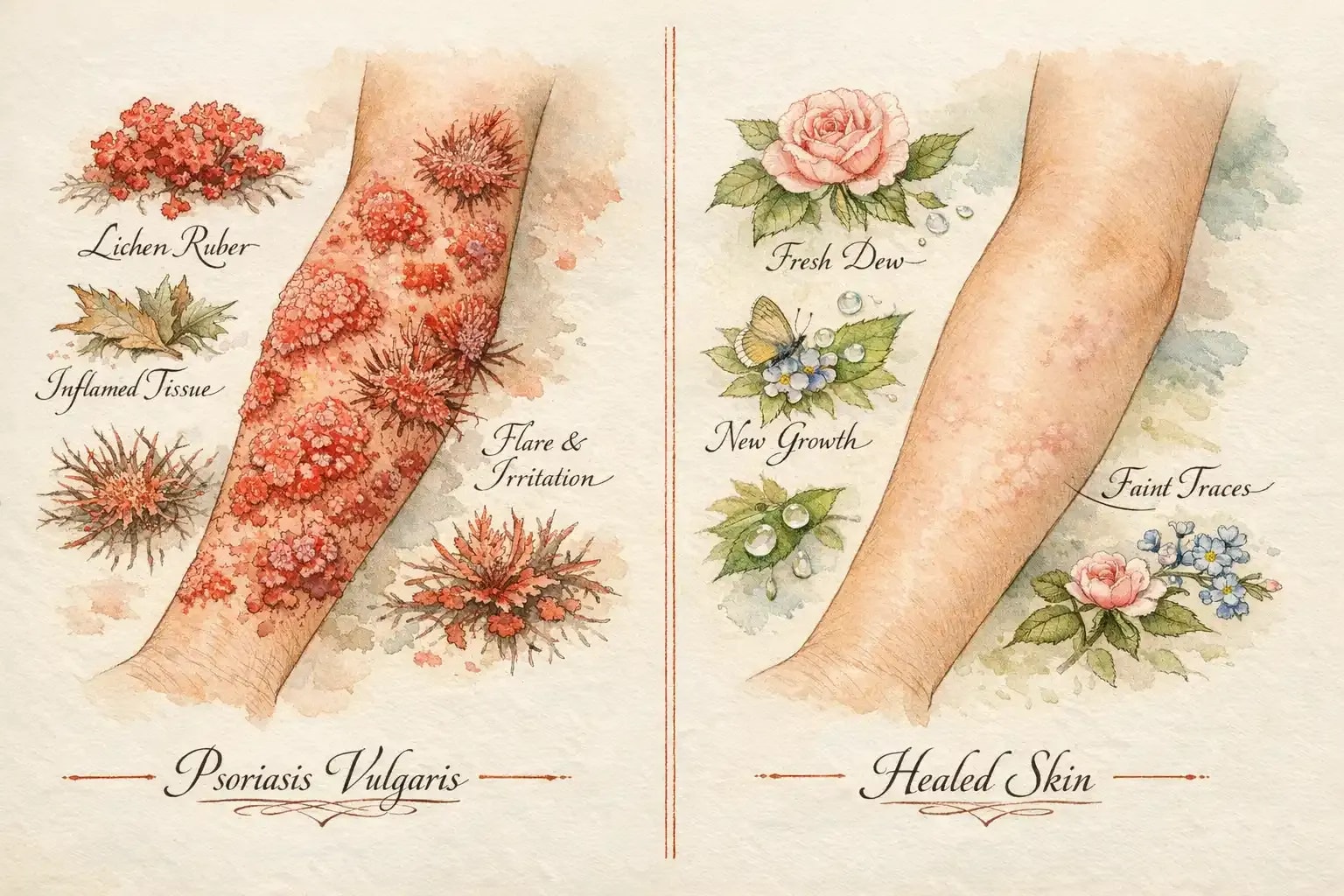
- Psoriasis patches: Dramatically reduced. Areas that were angry, red, and scaling have calmed significantly. Existing patches have shrunk and faded. New patches appear less frequently and resolve faster when they do appear.
-
Itchiness: This might be the most life-changing improvement of all. The constant, maddening itch that made me want to crawl out of my own skin? Greatly, greatly reduced. I can actually focus on life instead of fighting the urge to scratch.
-
Fibromyalgia pain: I want to be completely honest here—it's not gone. I'm not sure it ever will be completely. But it's significantly more manageable. I can function at a level I couldn't before. The bad days are less frequent, less severe, and I bounce back from them faster.
-
Overall inflammation: Reduced across the board. I can see it in my skin, feel it in my joints. My body is calmer, less reactive, more resilient.
-
Weight: From 106 kg to 92 kg. From BMI 32+ to BMI 27. From clinically obese to merely overweight—and still improving.
-
Breathing: Noticeably improved. I don't get winded climbing stairs anymore. Exercise feels challenging rather than torturous.
Mental and Quality-of-Life Changes
-
Energy levels: Dramatically improved. I have sustainable energy throughout the day instead of constant crushing fatigue punctuated by desperate caffeine hits. The difference is night and day.
-
Sleep quality: Better, deeper, more restorative. The tart cherry and magnesium have helped, but so has the reduced inflammation and increased physical activity. I wake up feeling actually rested now—a novelty after years of fibro-sleep.

- Productivity: Through the roof. When you're not fighting constant pain and fatigue, you can actually get things done. Novel concept, right? I accomplish more in my "shorter" workdays now than I did in marathon sessions before.

- Mental strength and resilience: Maybe the most important change of all. I feel capable. I feel strong. I feel like I can handle what life throws at me because I've proven to myself, over and over this year, that I can push through hard things and come out better on the other side.
Walking Into 2026

As I prepare to close the chapter on 2025, I feel something I haven't felt in years: genuine optimism about my health trajectory.
I'm not cured. I don't think "cured" is even the right framework for chronic conditions like psoriasis and fibromyalgia. But I am managing. I am thriving, even. I have tools that work, routines that support me, and most importantly, concrete proof that I can feel significantly better than I did a year ago.
My arsenal for 2026 remains largely the same—because when something works, you don't abandon it. I'll continue my daily SIBO yogurt rituals, my supplement stack, my fermentation practice, my movement routine, and yes, my stinky-but-miraculous pine tar soap.
Maybe I'll add new experiments. Maybe I'll refine what I'm already doing based on new research or personal discoveries. That's the beauty of this journey—it's never really finished. There's always more to learn, more to try, more ways to support this complicated, frustrating, miraculous body of ours.
If you're struggling with similar conditions, I hope something in this article sparks an idea for you. I hope you find your own healing arsenal. And I hope 2026 brings you closer to the version of yourself that feels genuinely, sustainably good.
Here's to another year of mindful fermentation—one jar, one step, one breath at a time.
Important Disclaimer
This article reflects my personal experience and journey—it is not medical advice. I am not a doctor or healthcare professional, and nothing in this article should be taken as a recommendation for your specific situation. What works for my body may not work for yours, and chronic conditions like psoriasis and fibromyalgia require individualized approaches under proper medical supervision.
Before starting any new supplement regimen, making significant dietary changes, or beginning an exercise program—especially if you have chronic health conditions—please consult with your healthcare provider. Do your own research. Make informed decisions based on your unique circumstances and in partnership with professionals who know your medical history.
I share my journey in the hope that it might inspire or inform others walking similar paths, but ultimately, you are responsible for your own health decisions. Be thoughtful, be careful, and work with qualified professionals who understand your individual needs.